Key takeaways
- Compare the best medicine balls for core work, strength training and partner drills, with five verified picks by weight, grip, bounce and build quality.
- Top Pick: Amazon Basics Weighted Medicine Ball, 10 Pounds
- Runner-up: Valeo Medicine Ball, 10 Pounds
- Also consider: CAP Barbell Rubber Medicine Ball, 10 Pounds
As an Amazon Associate, we earn from qualifying purchases.
The best medicine ball for most home gyms is the Amazon Basics Weighted Medicine Ball in the 10-pound size: it is a firm rubber ball with a textured grip, a moderate bounce for wall and partner work, and a diameter that suits both two-handed throws and core drills. If you prefer a traditional leather feel, the Champion Sports leather ball in the 11 to 12-pound size is the premium step up, while the CAP Barbell and RitFit balls cover the budget end in heavier and lighter weights. The five picks below are all classic rubber or leather medicine balls, compared by weight, shell material, grip texture, bounce, and diameter using published manufacturer and listing specifications only.
Table of Contents
- How to Choose a Medicine Ball
- 1. Amazon Basics Weighted Medicine Ball, 10 Pounds
- 2. Valeo Medicine Ball, 10 Pounds
- 3. CAP Barbell Rubber Medicine Ball, 10 Pounds
- 4. Champion Sports Exercise Medicine Ball, 11 to 12 Pounds
- 5. RitFit Weighted Medicine Ball, 2 Pounds
- Frequently Asked Questions
- Conclusion
- Product and ASIN Reference
How to Choose a Medicine Ball
A classic medicine ball is a firm, weighted ball designed for throws, catches, twists, and loaded core movements. It is not the same product as a slam ball, which is a soft, dead-bounce ball built to be thrown at the floor, or a wall ball, which is a large soft-shell ball built for target throws. Every pick in this roundup is a classic medicine ball, so the comparison stays on the features that separate one from another.
Weight is the first decision. Beginners and anyone training speed or rotational power usually start between 4 and 8 pounds, because form breaks down quickly when the ball is too heavy for fast movements. A 10-pound ball is the common middle ground for squats, lunges, chest passes, and Russian twists. Balls in the 11 to 12-pound range suit stronger users and slower strength work, while very light balls around 2 pounds are used for rehabilitation, warm-up drills, and high-repetition coordination work.
Shell material shapes both grip and bounce. Rubber balls are firm, hold a consistent round shape, and bounce off hard surfaces, which makes them practical for rebound wall throws and partner passes. Leather and synthetic leather balls feel softer in the hands, grip well even when palms sweat, and are the traditional choice in gyms and studios, although they are not meant to be slammed. Diameter matters too: smaller balls around 7.5 to 8.5 inches are easy to control with fast hand changes, while balls around 9.3 inches fill both palms and feel more stable for two-handed work.
Finally, check the surface texture. A textured or dual-texture finish helps the ball stay put during sweaty sets, and color coding by weight makes it faster to grab the right ball from a rack. None of the balls below is designed for full-force slamming into the floor; if slamming is the goal, that is a different product category entirely.
It also helps to think about where the ball will be used. Rubber balls tolerate garage floors, driveways, and rebound walls well, and they wipe clean in seconds. Leather balls belong indoors on gym flooring, where the cover stays smooth and the stitching is protected. If two people will train together, a mid-weight rubber ball in the 8 to 10-pound range is the most flexible shared purchase, because it is heavy enough for lower-body work and light enough for partner passing drills. Users who plan to progress should also confirm that the chosen brand sells the next weight up in the same style, since matching diameter and texture across weights makes moving up feel familiar instead of starting over with a different ball.
1. Amazon Basics Weighted Medicine Ball, 10 Pounds

Tier: mid-range
The Amazon Basics 10-pound ball is the straightforward pick for a first medicine ball. It is made of sturdy, firm rubber with a lightly textured surface, and at 9.3 inches in diameter it is large enough for comfortable two-handed catches yet still manageable for single-arm support work such as weighted push-up variations. The rubber shell bounces off hard surfaces, so it works for rebound drills against a solid wall and for partner tosses on a gym floor.
The line is color coded by weight, with the 10-pound version finished in blue and black, and sibling sizes run from 4 pounds up to 12 pounds on the same listing family, which makes it easy to add a lighter or heavier ball later in a matching style. For general circuits that mix squats, lunges, twists, and sit-ups, this is the most versatile single weight in the group.
Specs
- Weight: 10 pounds (this variant)
- Diameter: 9.3 inches
- Material: rubber
- Color: blue and black
- Surface: textured finish for grip
- Bounce: bounces off hard surfaces
- Also available in 4, 6, 8, and 12-pound sizes
- Part number: IB1023
2. Valeo Medicine Ball, 10 Pounds

Tier: mid-range
The Valeo 10-pound ball is a long-running design built around a sturdy rubber shell and a heavily textured finish, which gives it one of the most secure grips in this roundup for fast rotational work. Valeo balls run smaller than many rivals at roughly 8.5 inches across, and that compact size makes the ball easy to maneuver during quick hand-to-hand drills, diagonal chops, and overhead throws.
Each Valeo ball includes an exercise wall chart, a useful extra for beginners building a first routine. The range covers 4, 6, 8, 10, and 12 pounds, and each weight is a different color for quick identification. Like the Amazon Basics ball, the durable rubber construction allows the ball to bounce off hard surfaces, so it suits rebound and partner work rather than floor slams.
Specs
- Weight: 10 pounds (this variant)
- Diameter: approximately 8.5 inches
- Material: rubber
- Surface: textured finish for grip
- Includes: exercise wall chart
- Bounce: bounces off hard surfaces
- Also available in 4, 6, 8, and 12-pound sizes
- Model number: VA4505BL
3. CAP Barbell Rubber Medicine Ball, 10 Pounds

Tier: budget
The CAP Barbell rubber medicine ball in the 10-pound size, finished in red, is the value pick of the group. It uses a thick rubber wall with an embossed dual-texture surface, so the grip stays secure during demanding sets, and the shell is durable enough for bouncing drills off hard surfaces. CAP color codes each weight, and the weight is labeled on the ball itself, which helps in shared gym spaces.
The range runs from 2 pounds up to 12 pounds in six sizes, so there is room to progress without changing brands. CAP backs the ball with a 30-day manufacturer warranty, a detail most budget medicine balls do not offer. It is not designed for slamming, so keep it to throws, catches, and loaded core work and it will hold up well.
Specs
- Weight: 10 pounds (this variant)
- Material: rubber
- Color: red (color coded by weight)
- Surface: embossed dual-texture grip
- Bounce: bounces off hard surfaces; not designed for slamming
- Also available in 2, 4, 6, 8, and 12-pound sizes
- Warranty: 30-day manufacturer warranty
- Part number: HHKC-010
4. Champion Sports Exercise Medicine Ball, 11 to 12 Pounds

Tier: premium
The Champion Sports leather medicine ball in the 11 to 12-pound size is the heaviest and most traditional pick here. Its synthetic leather cover uses reinforced stitching and a no-slip texture that stays easy to hold even when hands get sweaty, which is why this style of ball is a fixture in school gyms, studios, and training facilities. The softer leather feel is also easier on the hands and forearms during high-repetition catching drills than a hard rubber shell.
This weight range suits stronger users doing slower strength work: loaded squats, step-ups, overhead presses, and controlled rotational movements. The leather line is sold in graduated weight bands, so lighter versions exist for smaller users. Leather balls should be kept away from floor slams and outdoor concrete, which can scuff and split stitched covers. Because the cover is stitched rather than molded, the ball also has a slightly softer catch than a rubber ball at the same weight, which many users prefer for high-repetition partner work and for training in shared spaces where a hard rubber ball feels harsh on the hands over long sessions.
Specs
- Weight: 11 to 12 pounds (this variant)
- Material: synthetic leather
- Construction: reinforced stitching
- Surface: no-slip grip texture
- Best for: strength training, stability, plyometrics, and core work
- Part number: MB11
5. RitFit Weighted Medicine Ball, 2 Pounds
Tier: budget
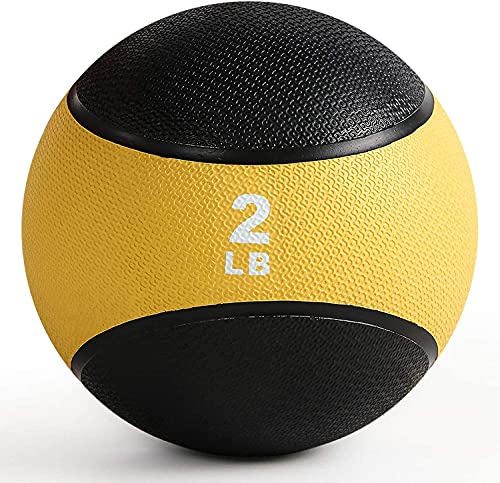
The RitFit weighted medicine ball in the 2-pound yellow variant fills the light end of the range. Both the shell and the inner bladder are rubber, and the dual-texture surface is designed to stay non-slip during fast, repetitive movements. At 7.5 inches in diameter it is the smallest ball in this roundup, which makes it easy to control for one-handed drills, shadow boxing patterns, and shoulder mobility work.
A 2-pound ball is not a strength tool; it is the right weight for rehabilitation exercises, warm-ups, physical therapy routines, and speed work where a heavier ball would slow the movement down. The same RitFit listing family offers heavier weights and other colors, so the light ball can be paired with a heavier sibling later. Like the other rubber balls here, it is made for throws and catches, not for slamming.
Specs
- Weight: 2 pounds (this variant)
- Diameter: 7.5 inches
- Material: rubber shell and bladder
- Color: yellow
- Surface: dual-texture, non-slip grip
- Best for: rehabilitation, warm-ups, coordination, and speed drills
- Heavier weights available on the same listing
Frequently Asked Questions
What weight medicine ball should a beginner start with?
Most beginners do well starting between 4 and 8 pounds for fast movements such as twists, chops, and chest passes, because technique matters more than load while the patterns are new. A 10-pound ball is a reasonable first purchase for general strength circuits if it can be moved with control, and very light balls around 2 pounds suit rehabilitation and warm-up work.
Can a classic medicine ball be used for slamming?
No. Classic rubber and leather medicine balls are built for throws, catches, and loaded core exercises, and repeated full-force slams can split seams or crack shells. Slamming calls for a slam ball, a separate product type with a soft, dead-bounce shell designed to absorb that impact.
What is the difference between a medicine ball and a wall ball?
A classic medicine ball is firm, usually rubber or leather, and sized for the hands, roughly 7.5 to 9.5 inches across in this roundup. A wall ball is a much larger soft-shell ball, commonly 14 inches across, made to be thrown at a wall target and caught; it does not bounce and is not used for the same close-range partner and core drills.
How should a medicine ball be stored and maintained?
Store the ball indoors on a rack or shelf, out of direct sunlight, and keep leather models away from concrete and outdoor surfaces that scuff the cover. Wipe rubber balls down with a damp cloth after workouts, check stitching on leather balls regularly, and retire any ball whose shell cracks or whose weight shifts unevenly inside.
Conclusion
For most people, the Amazon Basics 10-pound ball is the right first medicine ball: firm rubber, a secure textured grip, and a versatile middle weight. The Valeo 10-pound ball is the better pick when a smaller diameter and an included exercise chart matter, while the CAP Barbell 10-pound ball covers the same ground at the budget tier with a warranty behind it. Stronger users who want the traditional feel should look at the Champion Sports leather ball in the 11 to 12-pound size, and the light RitFit 2-pound ball rounds out the set for rehabilitation, warm-ups, and speed work. Match the weight to the movement first, then choose the shell and grip that fit how the ball will be used.