Key takeaways
- Compare the best air bikes for home gyms, including chain and belt fan bikes for intervals and conditioning, with advice on sizing, noise and consoles.
- Top Pick: Assault Fitness Assault AirBike Classic
- Runner-up: Schwinn Fitness Airdyne AD7
- Also consider: Schwinn Fitness Airdyne AD6
An air bike is the simplest conditioning tool in a home gym: a large fan replaces the flywheel, resistance rises automatically the harder the rider pushes, and moving handlebars turn a ride into a full-body effort. That self-scaling design makes fan bikes favorites for short intervals, warm-ups and finishers, but models differ in drive type, frame stiffness, console features and noise. This guide compares five air bikes sold on Amazon, from the commercial-style Assault AirBike Classic to compact Marcy fan bikes that fit a spare corner, and explains which design choices matter for home use.
As an Amazon Associate, we earn from qualifying purchases.
Quick answer
The Schwinn Airdyne AD7 is the best all-round air bike for most home gyms, thanks to its quiet belt drive, sturdy frame and interval-ready console. The Assault AirBike Classic remains the pick for interval training with its chain drive and direct feel. On a tighter budget, the Marcy AIR-1 covers the basics, while the Schwinn Airdyne AD6 and the Marcy NS-1000 suit lighter use and smaller spaces.
Assault Fitness Assault AirBike Classic
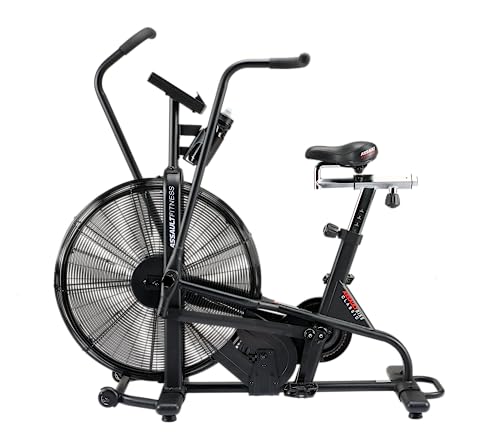
The Assault AirBike Classic is the bike that defined the modern fan bike category in functional gyms, and its design stays deliberately mechanical. A chain drive turns a 25-inch steel fan, producing unlimited air resistance that responds instantly to effort, and twenty sealed bearings across the frame and pivot points keep the action tight under hard use. The seat adjusts in multiple directions, including fore-aft and tilt, and the listed user capacity is 350 pounds. The LCD console tracks watts, calories, distance, time and heart rate, with interval programs including Tabata-style and custom formats. The steel frame feels planted during standing sprints, which is where lighter fan bikes can rock. Chain drive is the trade-off: it delivers a direct, connected feel but runs louder and needs occasional lubrication and tension checks. There is no Bluetooth app pairing, so data stays on the console. For home gym owners whose training centers on short, hard intervals and who want a bike built to commercial patterns, the Classic is the benchmark the others are measured against.
Schwinn Fitness Airdyne AD7
The AD7 takes the opposite approach to noise and maintenance by using a single-stage belt drive instead of a chain. The belt runs quieter, never needs lubrication, and drives a 26-inch fan with progressive air resistance. The frame supports riders up to 350 pounds, and the perimeter-weighted fan blades keep the stroke smooth at low cadence, which makes the AD7 unusually good for steady zone-two rides as well as intervals. The console offers interval programs, target-based workouts and heart rate tracking, powered by batteries so the bike can sit anywhere without an outlet. The seat is large and padded, with fore-aft and height adjustment, and the dual-action arms include footrests for lower-body-only riding. Multi-position hand grips let riders change leverage during long sessions. For shared households, the quieter drive is the deciding factor: early-morning or evening conditioning is far less disruptive than on a chain bike. Buyers wanting one air bike for both hard intervals and daily aerobic work, with minimal upkeep, will find the AD7 the most complete home option in this group.
Schwinn Fitness Airdyne AD6
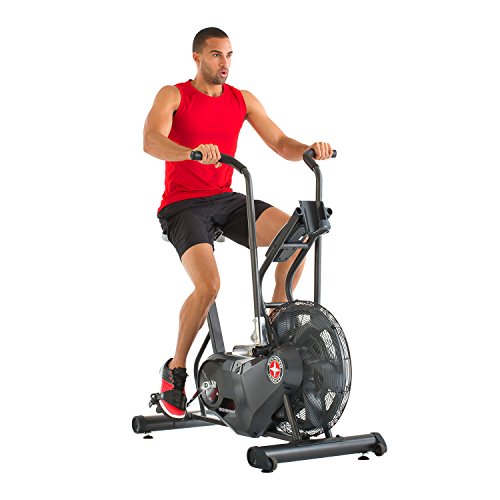
The AD6 is the long-running mid-range Airdyne, built around a single-stage fan with a quieter belt-style drive and a simpler feature set than the AD7. Its infinite air resistance still scales with effort, so intervals work, but the console is more basic, focusing on time, distance, calories and RPM with a large, easy-read display. The frame is lighter than the AD7 and the listed capacity is 250 pounds, which suits average-sized riders doing steady conditioning rather than maximal standing sprints. The seat adjusts vertically, and the moving arms include stationary foot pegs for arm-only work. Because the design has been sold for years, replacement parts and accessories are easy to source. The AD6 fits buyers who want the Airdyne feel and low maintenance without paying for the AD7’s heavier frame and richer console. It is also a reasonable choice for rehab-style low-resistance pedaling, since air resistance at slow cadence is very light. Households with heavier riders or aggressive sprint training should step up to the AD7 or the Assault Classic instead.
Marcy AIR-1 Fan Exercise Bike

The AIR-1 is the budget benchmark among fan bikes, pairing a steel fan with dual-action handlebars and a 14-gauge steel frame finished in powder coat. Air resistance rises with pedaling speed, and the moving arms add upper-body work so intervals engage the whole body. The listed user capacity is 300 pounds, and the frame stays reasonably steady during seated efforts and moderate sprints. A basic LCD shows time, speed, distance and calories, and the seat adjusts to fit different leg lengths. Transport wheels help move the bike between a garage gym and a storage corner. The fan also blows air back at the rider, a small comfort bonus during hard sessions. Ownership trade-offs are the simple console, a less refined seat than the Schwinn models, and more fan noise at high cadence. For buyers adding a first conditioning bike to a home gym, or equipping a garage setup where the bike shares space with strength equipment, the AIR-1 delivers the essential fan bike experience at the lowest commitment in this guide.
Marcy NS-1000 Fan Exercise Bike
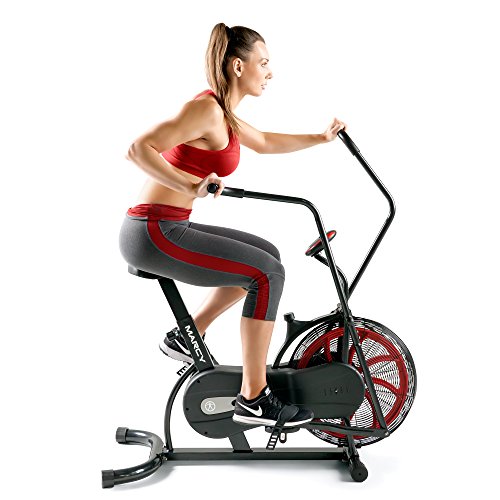
The NS-1000 is Marcy’s compact fan bike, finished in red and black, designed for smaller rooms and lighter riders. It uses the same air resistance principle, with dual-action handlebars and a fan that scales resistance to pedaling effort, but the frame is smaller and the listed capacity is 250 pounds. The console is a simple LCD tracking the core metrics, and the adjustable seat covers a modest range of heights. Its footprint suits apartments, bedrooms and office corners where the larger bikes in this guide would crowd the room. The lighter build means standing sprints feel less planted than on the AIR-1 or the commercial-style models, so it is best used for seated intervals, warm-ups and steady cardio. Assembly is straightforward, and transport wheels make it easy to roll into a closet. For smaller users who want fan bike conditioning without dedicating a large floor area, or as a secondary cardio piece beside a strength setup, the NS-1000 fills that niche. Heavier riders or those planning hard interval programs should choose the AIR-1 or a Schwinn model.
How to choose
Drive type is the first decision. Chain drives, like the Assault Classic, feel direct and tolerate abuse but run louder and need periodic lubrication. Belt drives, like the Schwinn Airdyne models, are quieter and nearly maintenance-free, which matters in shared homes. Next, check frame weight and user capacity: heavier frames stay stable during standing sprints, and capacities range from 250 to 350 pounds in this guide. Console needs vary; interval timers and watt readouts help structured training, while basic metric displays are fine for warm-ups and finishers. Consider seat quality for longer rides, since most stock fan bike seats are firm, and confirm the bike’s footprint plus clearance for the moving arms. Noise deserves honest thought, because every air bike gets loud at sprint effort as the fan moves more air; belt models reduce drivetrain noise but not fan whoosh. Finally, think about the training role: a bike bought for ten-minute finishers needs less console and comfort than one planned for forty-minute aerobic sessions.
Who should skip
Skip an air bike if the main goal is long, comfortable endurance riding, because the upright position, firm seats and rising resistance make fan bikes better for intervals than for hour-long cruises; a recumbent or a spin bike fits that role better. Anyone with downstairs neighbors and a sprint-heavy program should consider the noise at full effort. Riders who want guided classes, automatic resistance changes or detailed app metrics will not find them here. And buyers who dislike full-body effort may prefer a legs-only machine, since the moving arms are central to how these bikes train.
FAQ
Are air bikes good for interval training?
Yes, interval training is their strongest use. Air resistance rises instantly with effort, so a rider can sprint for twenty seconds and recover at an easy spin without pressing any buttons. Most models in this guide include interval programs or timers on the console, and the full-body action raises heart rate quickly, making short sessions effective for conditioning.
How loud is an air bike in an apartment?
Fan noise grows with effort: easy pedaling is a soft whoosh, while hard sprints are loud enough to carry through a door. Belt-drive models like the Schwinn Airdyne AD7 remove chain noise and are the better apartment choice. A floor mat, closed door and avoiding late-night sprint sessions keep most households and neighbors comfortable.
What is the difference between chain and belt drive fan bikes?
Chain drives feel direct and are common on commercial-style bikes, but they need occasional lubrication and tension checks and produce more mechanical noise. Belt drives run quieter, need almost no maintenance, and feel slightly smoother at low cadence. Both use the same air resistance principle, so workout quality is similar; the choice is about noise and upkeep.
How much space does an air bike need?
Most air bikes occupy about 50 by 25 inches of floor, similar to a small desk, and the models here include transport wheels for storage against a wall. Leave extra room at the sides for the moving handlebars and behind the bike for mounting. Ceiling height is rarely an issue, since even standing pedaling keeps the rider below typical room heights.
Final verdict
The Schwinn Airdyne AD7 is the best fit for most home gyms, combining a quiet belt drive, a stable frame and a console that handles both intervals and steady work. The Assault AirBike Classic is the choice for uncompromising interval training and commercial-style build. The Marcy AIR-1 covers the essentials for less, the Airdyne AD6 offers low-maintenance value, and the Marcy NS-1000 serves small spaces and lighter riders.