Key takeaways
- Compare the best chest strap heart rate monitors for running, cycling and gym training, with ANT+ and Bluetooth specs, battery life and fit advice.
- Top Pick: Polar H10 Heart Rate Monitor Chest Strap
- Runner-up: Powr Labs Bluetooth and ANT+ Heart Rate Monitor Chest Strap
- Also consider: CooSpo H808S Heart Rate Monitor Chest Strap
The best chest strap heart rate monitors read the electrical signal of your heartbeat directly from the chest, which makes them faster to react and steadier during intervals than a wrist-based optical sensor. For most runners and gym trainees, the Polar H10 is the reference pick: dual Bluetooth and ANT+ connections, a built-in memory for one session, and a strap that stays put. Garmin’s HRM-Pro Plus adds running dynamics for Garmin watch owners, the Wahoo TRACKR swaps the coin cell for a rechargeable battery, and Powr Labs and CooSpo cover the budget tier with the same dual-protocol connections. Below are five chest straps compared on connectivity, battery type, water rating, and strap fit, grouped into budget, mid-range, and premium tiers.
As an Amazon Associate, we earn from qualifying purchases.
Table of Contents
- What to Look for in a Chest Strap Heart Rate Monitor
- Polar H10 Heart Rate Monitor Chest Strap
- Garmin HRM-Pro Plus Heart Rate Monitor
- Wahoo TRACKR Heart Rate Monitor
- Powr Labs Bluetooth and ANT+ Heart Rate Monitor Chest Strap
- CooSpo H808S Heart Rate Monitor Chest Strap
- Frequently Asked Questions
- Conclusion
- Product and ASIN Reference
What to Look for in a Chest Strap Heart Rate Monitor
Connectivity decides what the strap can talk to. Almost every current strap broadcasts on both Bluetooth Low Energy and ANT+, and that pairing covers phones, watches, bike computers, treadmills, rowers, and apps such as Zwift, TrainerRoad, Strava, and Peloton. The detail worth checking is how many Bluetooth connections the sensor supports at once: a strap with two Bluetooth channels can feed a watch and a phone app simultaneously, while a single-channel strap forces you to choose. ANT+ has no practical connection limit, so gym equipment and bike computers rarely cause conflicts.
Battery design splits the category in two. Coin cell models run for months on a replaceable CR2032 or CR2025 cell, and the best of them approach a full year of daily training before the cell needs changing. Rechargeable models remove the battery swaps but need a charging cable every few weeks of training, and the battery cannot be replaced when it eventually wears out. Neither design is wrong; the choice is between long unattended runtime and never buying coin cells.
Water rating matters if you swim or train in heavy rain. A strap rated for swimming, such as a 5 ATM or 30 meter rating, keeps working in the pool, although Bluetooth does not transmit through water, so the strap must store the session and forward it afterwards, or pair over ANT+ to a watch worn in the water. An IPX7 or IP67 rating covers sweat and rain but is not a swimming rating, and those straps should come off before a swim session.
Fit is a sizing question, not a comfort extra. The strap must sit snug on bare skin just below the chest muscles, with the electrode area moistened so the sensor picks up a clean signal from the first minute. Straps come in fixed size ranges, so measure your chest and check the range before ordering; a strap that is too large will slip during hard efforts no matter how good the sensor is. Silicone grip dots on the inside of the strap and a secure buckle both help the strap stay in place during intervals and lifting.
Extra data separates the premium tier. Basic straps broadcast heart rate and, in most cases, heart rate variability. Premium models add features such as running dynamics (ground contact time, stride length, vertical oscillation) when paired with a compatible watch, onboard memory that records a session without any watch or phone nearby, and activity tracking stored on the strap itself. Buy those features only if your watch or app can actually use them, because running dynamics in particular only work inside the matching brand ecosystem.
Care is simple but decides how long a strap lasts. Rinse the textile strap after sweaty sessions, detach the sensor pod when the maker recommends it, and machine wash the strap only as often as the manual allows. The elastic and electrodes degrade over time, and a worn strap is the most common cause of erratic readings, dropouts, and implausible spikes. Every brand here sells replacement straps, so a tired strap does not mean replacing the whole monitor.
Polar H10 Heart Rate Monitor Chest Strap

Tier: Premium
The Polar H10 is the strap most often used as the accuracy reference for the whole category, and it earns that place on connections alone: it broadcasts on ANT+ and on two simultaneous Bluetooth channels, so it can feed a watch, a phone, and gym equipment in the same session. It also carries built-in memory that stores one full training session, which makes it the natural pick for swimming, team sports, and any workout where a watch stays in a locker. The sensor measures heart rate variability as well as heart rate, receives firmware updates through the Polar apps, and runs on a replaceable CR2025 cell rated for up to 400 hours. It ships with the Polar Pro strap, which uses improved electrodes, a buckle closure, and silicone dots to keep the strap from sliding. This listing is the black M-XXL size; an XS-S strap size is sold under a separate listing.
Specs
- Connectivity: Bluetooth Low Energy (two simultaneous connections) and ANT+
- Battery: CR2025 coin cell, replaceable, up to 400 hours
- Water rating: waterproof to 30 meters, suitable for swimming
- Memory: built-in, stores one training session
- Data: heart rate and heart rate variability, ECG-based measurement
- Strap: Polar Pro textile strap, size M-XXL on this listing
- Model number: 92075957
Garmin HRM-Pro Plus Heart Rate Monitor
Tier: Premium
The HRM-Pro Plus is the premium pick for runners who already train with a Garmin watch. Alongside heart rate and heart rate variability over ANT+ and Bluetooth, it captures running dynamics such as ground contact time balance, stride length, vertical oscillation, and vertical ratio, and sends them to compatible Garmin devices. It stores heart rate data during swims and other out-of-range activities and forwards the file when the watch reconnects, and it can also track steps, calories, and intensity minutes on its own. The battery door opens without tools, a small change that makes the yearly CR2032 swap far easier than on the older model. Garmin rates the cell for up to 12 months at an hour of training per day. The strap adjusts across a wide chest range and the unit carries a 5 ATM water rating for pool work.
Specs
- Connectivity: ANT+ and Bluetooth Low Energy (two simultaneous Bluetooth connections)
- Battery: CR2032 coin cell, replaceable, up to 12 months at 1 hour per day
- Water rating: 5 ATM, suitable for swimming
- Data: heart rate, heart rate variability, running dynamics with compatible Garmin devices
- Storage: stores heart rate during swims and out-of-range activities, forwards on reconnect
- Strap range: about 23.5 to 42 inches (size XS-XL)
- Model number: 010-13118-00
Wahoo TRACKR Heart Rate Monitor
Tier: Mid-range
The TRACKR is Wahoo’s rechargeable answer to the coin cell straps. A built-in lithium battery rated for up to 100 hours of training removes battery swaps entirely, and the pod recharges with the included USB cable. It broadcasts over ANT+ and Bluetooth, with support for multiple simultaneous Bluetooth connections, so a bike computer, a watch, and an app can all listen at once. LED lights on the pod confirm power and connection status at a glance, which is genuinely useful when pairing before a ride. The unit is rated IPX7, so sweat and rain are covered, but that rating is not a swimming specification and Wahoo does not position the TRACKR as a pool strap. For cyclists and runners who dislike coin cells and train mostly on land, it is the most convenient mid-range option in this roundup.
Specs
- Connectivity: ANT+ and Bluetooth, multiple simultaneous Bluetooth connections
- Battery: built-in rechargeable lithium battery, up to 100 hours, USB charging cable included
- Water rating: IPX7 (sweat and rain; not rated for swimming)
- Indicators: LED lights for power and connection status
- Included components: TRACKR pod, chest strap, setup guide, charging cable
- Model number: WFBTHR05W
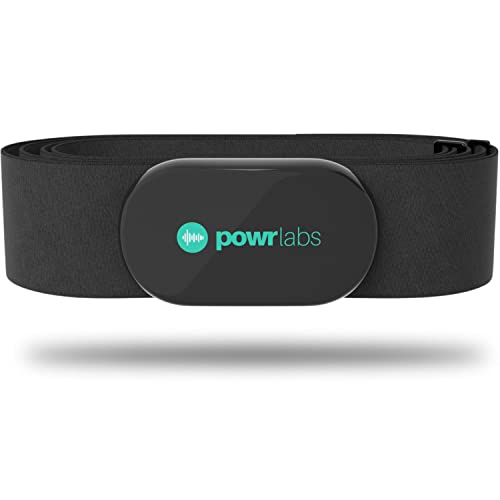
Powr Labs Bluetooth and ANT+ Heart Rate Monitor Chest Strap
Tier: Budget
Powr Labs keeps the essentials and drops the extras. The strap broadcasts heart rate over Bluetooth and ANT+ at the same time, pairs with phones, watches, Peloton bikes, and gym equipment, and runs on a standard replaceable CR2032 cell. The brand’s own fit guidance puts the adjustable strap at 24 to 40 inches of chest, which covers most adults, and the pod snaps onto the strap so the textile band can be washed on its own. There is no onboard memory, no running dynamics, and no swimming storage here; what you get is a clean dual-protocol heart rate signal for app-based training at the lowest tier of this roundup. For a first chest strap, or a spare kept in a gym bag, that trade is sensible.
Specs
- Connectivity: Bluetooth and ANT+, simultaneous broadcast
- Battery: CR2032 coin cell, replaceable
- Strap range: adjustable, about 24 to 40 inches of chest
- Compatibility: phones, watches, Peloton, Garmin, Wahoo and gym equipment via Bluetooth and ANT+
- Construction: snap-off sensor pod, washable textile strap
- UPC: 742042607242
CooSpo H808S Heart Rate Monitor Chest Strap
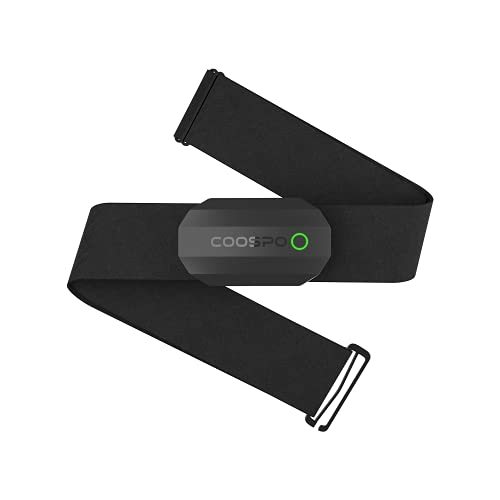
Tier: Budget
The H808S is CooSpo’s long-running budget strap, built around battery life: the replaceable CR2032 cell is rated for up to 300 hours of training, which for most people means a year or more between changes. It connects over Bluetooth and ANT+, works with the usual training apps including CooSpoRide, Wahoo Fitness, Strava, and Peloton, and adds a small LED indicator and a beep so you know the sensor is awake and reading before you start. The housing is rated IP67, enough for sweat, rain, and muddy rides, though not for swimming. CooSpo also sells a rechargeable sibling model, the H9Z, but the H808S is the pick here because its listing data is the cleaner of the two and the coin cell runtime suits riders and runners who forget to charge things.
Specs
- Connectivity: Bluetooth and ANT+
- Battery: CR2032 coin cell, replaceable, up to 300 hours
- Water rating: IP67 (sweat and rain; not for swimming)
- Indicators: LED light and audible beep on activation
- Compatibility: CooSpoRide, Wahoo Fitness, Strava, Peloton and other Bluetooth or ANT+ apps
- Model number: H808S
Frequently Asked Questions
Are chest strap heart rate monitors more accurate than watch sensors?
Chest straps measure the heart’s electrical signal directly, the same principle as a medical ECG, while watches estimate heart rate from blood flow at the wrist. In steady exercise both approaches are close, but during intervals, cold weather, and gripping handlebars or weights, the wrist signal degrades first. A chest strap reacts faster to pace changes and produces fewer spikes and dropouts, which is why structured zone training is usually prescribed against strap data.
Will one of these straps work with Peloton, Zwift, and gym equipment?
In most cases, yes. Every strap in this roundup broadcasts on both Bluetooth and ANT+, and Peloton bikes, Zwift, and most modern treadmills and rowers accept at least one of those protocols. The practical limit is Bluetooth channels: a strap with two Bluetooth connections can feed a bike and a phone at once, while a single-connection strap must be disconnected from one device before it pairs with another.
Should I choose a coin cell or a rechargeable strap?
Choose a coin cell if you want the longest unattended runtime; the straps here run from about 300 hours to a full year of daily training on one cell, and replacements are cheap and sold everywhere. Choose a rechargeable model such as the Wahoo TRACKR if you prefer never to open a battery door, and accept a charge every few weeks and a battery that cannot be replaced at end of life.
Can I swim with a chest strap heart rate monitor?
Only with a strap rated for it. The Polar H10 (30 meter rating) and the Garmin HRM-Pro Plus (5 ATM) are built for the pool; the IPX7 and IP67 models in this roundup are rain and sweat ratings, not swimming ratings. Note that Bluetooth does not pass through water, so a swimming strap either stores the session internally and uploads it afterwards, like both premium picks here, or talks to a nearby watch over ANT+.
Conclusion
For most people, the Polar H10 is the strap to buy first: reference-grade heart rate and variability data, two Bluetooth connections plus ANT+, a session of onboard memory, and a genuine swimming rating. Garmin watch owners who want running dynamics should step up to the HRM-Pro Plus, which adds those metrics and a tool-free battery door. The Wahoo TRACKR suits riders and runners who would rather charge than swap coin cells, while the Powr Labs strap and the CooSpo H808S deliver the same dual-protocol signal at the budget tier, the CooSpo standing out for its 300-hour battery rating. Whichever tier you choose, size the strap to your chest and keep the electrodes moist; fit and contact decide reading quality more than brand does.