Key takeaways
- Compare the best stability balls by published specs: sizes from 45 to 95 cm, anti-burst PVC shells, included pumps and load ratings from five brands.
- Top Pick: Trideer Exercise Ball
- Runner-up: TheraBand Pro Series Exercise Ball
- Also consider: Gaiam Total Body Balance Ball Kit
The best stability ball for most home gyms is a 65 cm anti-burst ball with a textured, non-slip surface and a pump in the box, and the Trideer Exercise Ball is the clearest match for that brief, with five sizes, an anti-burst PVC shell and a quick pump included. Buyers who want clinic-grade construction should look at the TheraBand Pro Series instead, while the Gaiam Total Body Balance Ball Kit suits taller users who want a 75 cm ball bundled with a workout video.
A stability ball looks simple, but the published specs separate the serious training tools from the novelty items: shell thickness, anti-burst behavior, the size range on the listing, and whether a pump and spare plugs are included. This guide compares five exercise balls on those published specs only, grouped into budget, mid-range and premium tiers, so you can match a ball to your height, your floor space and the way you train.
As an Amazon Associate, we earn from qualifying purchases.
Table of Contents
- How to Choose a Stability Ball
-
- Trideer Exercise Ball
-
- TheraBand Pro Series Exercise Ball
-
- Gaiam Total Body Balance Ball Kit
-
- DynaPro Exercise Ball
-
- Live Infinitely Exercise Ball
- Frequently Asked Questions
- Conclusion
- Product and ASIN Reference
How to Choose a Stability Ball
Start with size. Ball diameter is matched to your height. The sizing pattern used across these brands is consistent: 45 cm for users under about 5 feet, 55 cm for roughly 5 feet 1 inch to 5 feet 6 inches, 65 cm for roughly 5 feet 7 inches to 6 feet 1 inch, 75 cm for users over 6 feet 1 inch, and 85 cm or 95 cm for the tallest users or for extra seat height at a desk. When you sit on a correctly sized ball, your thighs should sit roughly parallel to the floor with your knees near a right angle.
Check the anti-burst design. Anti-burst does not mean puncture-proof. It means the shell is built so that if it is punctured, it deflates slowly instead of popping, which gives you time to get off safely. Every ball in this guide uses an anti-burst or slow-deflate design, and that is the single most important safety spec in the category.
Read load ratings carefully. Brands publish static load figures, and they vary widely, from conservative tested numbers on clinic-grade balls to very large marketing figures on budget balls. A static rating describes weight resting on the ball, not the force of bouncing or weighted exercise, so treat the biggest numbers as a durability signal rather than a working limit.
Look at what is in the box. Most of these balls ship with a hand pump, and some add spare plugs, a plug remover, a measuring tape or a workout guide. A tape or a marked inflation guide matters more than it sounds, because an under-inflated ball measures smaller than its stated size and changes the training effect.
Weigh shell thickness and surface finish. Wall thickness is the spec behind the anti-burst claim: thicker PVC shells, like the extra-thick shells DynaPro and Live Infinitely publish, resist slow leaks and hold their shape under repeated load better than thin shells. Surface finish matters just as much in practice. A matte or ridged surface grips the floor and your clothing during bridges, wall squats and plank work, while a glossy shell can skate on hardwood and laminate. If the ball will double as a desk seat, a textured finish also keeps the ball from creeping away every time you shift your weight.
Plan where the ball will live. A 65 cm ball is a large object in a small room, and an 85 cm or 95 cm ball is larger still. Balls deflate for storage and travel, but daily users rarely deflate them, so measure your corner, closet or under-desk space against the inflated diameter before choosing a size at the top of the range.
1. Trideer Exercise Ball

Trideer’s exercise ball is the mid-range all-rounder in this guide and the ball that fits the widest range of buyers. The listing covers five sizes from 45 cm to 85 cm, so a household with users of different heights can stay on one product line, and the shell is an anti-burst PVC design with a non-slip surface for floor work.
The ball is sold for yoga, Pilates, core training, physical therapy and active sitting, and it ships with a quick pump, which removes the most common first-day frustration in this category. Trideer also sells a separate pregnancy and birthing variant, but the standard exercise ball here is the general training model, and it is the version to choose for workouts and desk use.
For buyers who want one ball that handles core work, stretching and chair duty without moving into clinic pricing, this is the balanced pick. The five-size spread also makes returns for fit less likely: if your seated knee angle feels wrong on a 65 cm, the same listing family offers the 55 cm and 75 cm steps without changing brands, pumps or accessories.
Specs
- Sizes: 45, 55, 65, 75 and 85 cm
- Material: PVC
- Construction: anti-burst, slow deflation if punctured
- Surface: non-slip
- Includes: quick pump
- Model: TR002
- Tier: mid-range
2. TheraBand Pro Series Exercise Ball
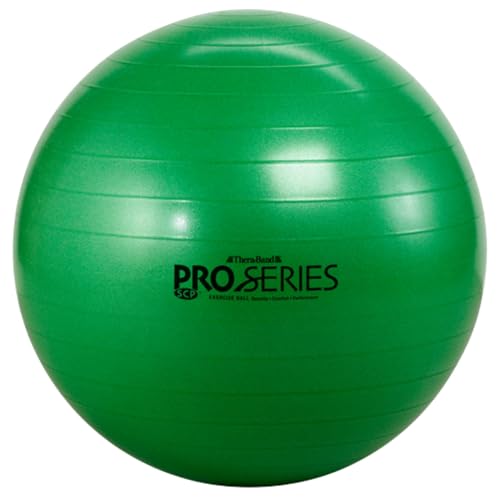
The TheraBand Pro Series is the premium, clinic-grade option. TheraBand built its name in physical therapy, and the Pro Series ball is the slow-deflate SCP design used in rehab settings, sized and color-coded by diameter. The variant pinned in this guide is the 65 cm green ball, model 23035, which the brand matches to users from 5 feet 7 inches to 6 feet 1 inch tall.
Where budget balls compete on headline load figures, the Pro Series competes on construction discipline: a burst-resistant PVC shell, a controlled slow-deflate behavior and a sizing system that therapists use to fit patients precisely. The same line runs from 45 cm up to 85 cm, so shorter and taller users can stay within the same professional range.
Choose this ball if the ball will see daily rehab work, clinic use, or heavy training where a conservative, professional spec matters more than the lowest tier pricing.
Specs
- Size (pinned variant): 65 cm (26 inch), green
- Model: 23035
- Height fit: 5 feet 7 inches to 6 feet 1 inch
- Design: Pro Series SCP slow-deflate
- Material: burst-resistant PVC
- Item weight: 2.5 lb
- Line sizes: 45, 55, 65, 75 and 85 cm
- Tier: premium
3. Gaiam Total Body Balance Ball Kit
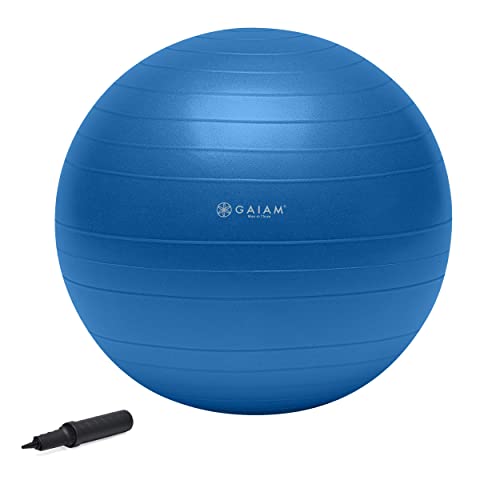
Gaiam packages its balance ball as a kit, and the Total Body Balance Ball Kit, model 05-52205, is built around a 75 cm anti-burst ball, which makes it the natural pick for taller users in this guide. Alongside the ball, the box includes an air pump and a workout video, so the kit arrives as a complete starter package rather than a ball alone.
The ball itself uses a textured grip surface, a useful detail for floor exercises where a smooth shell can creep on hard floors, and Gaiam positions the line for core work, yoga and active seating. Because the kit fixes the size at 75 cm, shorter users should pick a different entry in this guide rather than sizing down within this listing.
Pick the Gaiam kit if you are tall, want the guided workout content in the box, and prefer a long-established yoga brand over a marketplace label.
Specs
- Size: 75 cm ball
- Model: 05-52205
- Includes: air pump and workout video
- Construction: anti-burst
- Surface: textured grip
- UPC: 018713522054
- Tier: premium
4. DynaPro Exercise Ball

DynaPro takes the heavy-duty marketing route: an extra-thick eco-friendly PVC shell and a published rating of over 2,200 pounds of static load. Independent coverage of the brand puts the shell thickness at 1,877 micrometers, which is thick for this category and lines up with the anti-burst, slow-deflation behavior the brand describes.
The line covers four sizes from 45 cm to 75 cm in four colors, and a hand pump is included. Read the load figure the way it should be read across this whole category: it is a static rating, not a promise about dynamic training loads, and the practical reasons to choose DynaPro are the thick shell, the size spread and the included pump at a mid-range tier.
This is the pick for buyers who want the thickest shell they can get without paying clinic-grade prices, and who are comfortable treating headline load numbers as marketing rather than engineering.
Specs
- Sizes: 45, 55, 65 and 75 cm
- Material: eco-friendly PVC, extra thick
- Published static rating: over 2,200 lb
- Construction: anti-burst
- Includes: hand pump
- Colors: black, blue, grey and pink
- Tier: mid-range
5. Live Infinitely Exercise Ball

Live Infinitely is the budget pick with the widest size range in this guide: five sizes running from 55 cm all the way to 95 cm, the largest ball here, which makes it the default option for very tall users and for anyone who wants maximum seat height at a desk.
The ball is an extra-thick professional-grade PVC design with non-slip ridges, anti-burst testing and a published 2,200 pound static figure, and the brand states the shell can withstand a 2 cm cut without bursting. The box is generous for the tier: a hand pump, two air plugs, a valve remover tool and access to digital workout guides. The brand also backs the ball with a one-year warranty.
One honest caution from published coverage of this ball: sizing can run slightly small, with a 65 cm ball sometimes measuring a little under its stated diameter, so inflate fully, measure before training, and consider the next size up if you sit between sizes.
Specs
- Sizes: 55, 65, 75, 85 and 95 cm
- Material: professional-grade PVC, extra thick
- Published static rating: 2,200 lb, anti-burst tested
- Surface: non-slip ridges
- Includes: hand pump, two air plugs, valve remover, workout guide access
- Warranty: 1 year
- Tier: budget
Frequently Asked Questions
What size stability ball should I choose for my height?
Match the diameter to your height: 45 cm under about 5 feet, 55 cm for roughly 5 feet 1 inch to 5 feet 6 inches, 65 cm for roughly 5 feet 7 inches to 6 feet 1 inch, and 75 cm above that, with 85 cm and 95 cm reserved for the tallest users. Seated, your thighs should rest close to parallel with the floor. If you plan to use the ball mainly as a desk seat, several brands suggest going one size up from your exercise size.
What does anti-burst actually mean on an exercise ball?
Anti-burst means the shell is designed to deflate slowly if it is punctured, rather than bursting suddenly and dropping you to the floor. It is a safety behavior, not puncture immunity, so you should still keep the ball away from sharp edges, pet claws and rough surfaces, and inspect the shell before use.
Can a stability ball replace an office chair all day?
A stability ball can work as an active seat for part of the day, and every ball in this guide is sold partly for that use, but most guidance around ball chairs suggests building up sitting time gradually rather than swapping a full workday at once. Correct sizing matters more at a desk than in training, because your eye line and elbow height have to match your screen and work surface.
How firm should a stability ball be when properly inflated?
Inflate to the stated diameter, not to a feeling. A correctly filled ball gives slightly under your weight while keeping your hips level with or just above your knees when seated. Several kits include a measuring tape or an inflation guide for exactly this reason, and balls also stretch during the first day, so top the ball up once after the first 24 hours.
Conclusion
For most home gyms, the Trideer Exercise Ball is the straightforward recommendation: five sizes, an anti-burst shell, a non-slip surface and a pump in the box at a mid-range tier. The TheraBand Pro Series is the upgrade for rehab and clinic-grade discipline, the Gaiam kit serves taller users who want guided content included, DynaPro offers the thickest shell in the mid-range, and Live Infinitely covers the budget tier with the widest size range of the five. Whichever ball you choose, size it to your height first and inflate it to its stated diameter before judging the fit.