Key takeaways
- Compare the best treadmills for home gyms, from compact folding models to connected smart decks, with guidance on motors, deck size, incline and storage.
- Top Pick: Sunny Health and Fitness SF-T4400 Folding Incline Treadmill
- Runner-up: Xterra Fitness TR150 Folding Treadmill
- Also consider: NordicTrack T 6.5 S Treadmill
A home treadmill removes the two biggest obstacles to consistent cardio: weather and travel time. The challenge is that home models vary enormously in motor strength, deck size, incline range and folding design, and the wrong match can leave a runner with a cramped stride or a walker paying for power that never gets used. This guide compares five well-known folding treadmills that cover the main home use cases, from apartment-friendly walking decks to cushioned machines built for daily running. Each pick below is a current Amazon listing, and the sections that follow explain how the motor, belt dimensions and incline system should drive the decision.
As an Amazon Associate, we earn from qualifying purchases.
Quick answer
For most home gyms, the Xterra Fitness TR150 is the balanced pick, pairing a 50-inch deck, 250-pound capacity and preset programs in a folding frame. Runners wanting cushioning and connected training should look at the NordicTrack T 6.5 S, while the Sunny SF-T4400 suits smaller spaces. The Horizon T101 adds Bluetooth and simple controls, and the Sunny SF-T7515 brings automatic incline.
Sunny Health and Fitness SF-T4400 Folding Incline Treadmill
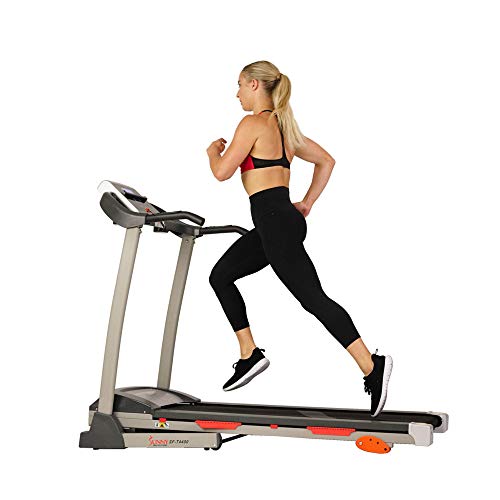
The SF-T4400 is the compact starting point in this group, built around a 2.2 peak horsepower motor with a speed range from 0.5 to 9 miles per hour. The running surface measures about 49 by 16 inches, which fits walking and light jogging strides comfortably but feels short for tall runners at full pace. Three manual incline levels add intensity without a motorized lift, and changing them means stepping off and resetting the deck angle by hand. The frame folds upright and rolls on transport wheels, so it can live against a wall between sessions. A device holder and a simple LCD console cover the basics: speed, time, distance, calories and pulse from the hand sensors. The listed user capacity is 220 pounds, the lowest here, which makes this a sensible pick for lighter users in apartments or spare rooms rather than households sharing one machine. Shock absorption under the deck softens impact for walking workouts. Buyers who mostly walk, recover from injury at low speeds, or need a treadmill that stores in a closet-sized footprint will find the SF-T4400 covers those needs without paying for running-grade hardware.
Xterra Fitness TR150 Folding Treadmill

The TR150 steps up to a 2.25 horsepower motor, a top speed of 10 miles per hour and a 16 by 50 inch running deck, a combination that handles jogging intervals more comfortably than the smallest budget decks. The user capacity rises to 250 pounds, and the console includes 12 preset programs plus three manual incline settings, so workouts can vary without manual planning. A 5-inch LCD tracks speed, incline, time, distance, calories and pulse, and the hand pulse grips sit within easy reach on the front rail. The deck folds with a lift-assist design and lowers slowly when released, which matters in homes with children or hard floors. Transport wheels make repositioning manageable for one person. At roughly 63 inches long when open, it still fits most spare bedrooms and garage gym corners. The TR150 makes sense as the household all-rounder: enough deck and speed for a beginner runner, enough programming for a walker who gets bored, and a folding frame that does not demand a dedicated gym room. It lacks Bluetooth app pairing, so buyers who want streamed classes should compare the connected models below.
NordicTrack T 6.5 S Treadmill

The T 6.5 S is the runner-focused option here, with a 2.6 horsepower continuous-duty motor, speeds up to 10 miles per hour and a roomier 20 by 55 inch deck that gives taller runners proper stride length. Ten motorized incline levels adjust from the console mid-workout, which supports hill intervals without breaking rhythm. The FlexSelect cushioning system lets the deck feel softer or firmer by rotating the deck cushions, a rare adjustment at this level. User capacity reaches 300 pounds, the highest in this guide alongside the Horizon and the SF-T7515. The SpaceSaver frame folds vertically, and the 5-inch display pairs with iFIT through a separate device and membership for streamed studio and outdoor routes. Twenty onboard workout programs are included for use without the subscription. Assembly is a two-person job given the machine weight near 200 pounds. For runners logging daily miles indoors, training through winter, or sharing the machine across a wide range of body sizes, the T 6.5 S offers the most complete package in this group, provided the extra footprint and iFIT ecosystem fit the plan.
Horizon Fitness T101 Folding Treadmill
The T101 takes a simplicity-first approach that suits walkers and casual joggers who find dense consoles annoying. Its dial controls adjust speed and incline with a twist instead of layered menus, and the deck offers a 20 by 55 inch running surface with a 300-pound user capacity. The 2.5 horsepower motor reaches 10 miles per hour, and the motorized incline climbs through ten levels. Bluetooth connectivity streams audio through the built-in speakers and can pair with training apps on a tablet, while a device rack and USB charging port keep a phone in view and powered. The FeatherLight folding system uses a hydraulic lift, so raising and lowering the deck takes little effort. Horizon backs the frame and motor with lifetime coverage, which stands out in this price band and matters for a machine expected to serve for years. The T101 fits households that want a shared, easy machine: grandparents walking daily, beginners building a jogging habit, and anyone who values warranty length and straightforward controls over a large touchscreen or subscription content library.
Sunny Health and Fitness SF-T7515 Smart Treadmill

The SF-T7515 is the value route to automatic incline, a feature the cheaper manual models skip. Its motorized incline adjusts through 12 levels from the console, and the top speed of 8 miles per hour targets walking, incline walking and light jogging rather than sprint work. The deck measures about 49 by 16.5 inches with double-deck shock absorption, and the listed capacity is 300 pounds. Bluetooth pairing connects to the SunnyFit app for workout tracking and guided sessions, and the console adds a BMI calculator, pulse sensors and dedicated speed buttons for quick jumps between paces. The frame folds for storage and includes a device holder and built-in speakers. Because the motor is smaller than the running-focused picks, long high-speed sessions are not its strength; it is better understood as an incline-walking machine with jogging ability. Buyers whose training centers on steep walking intervals for calorie burn, or who want app tracking without a subscription treadmill, get a lot of function here. The soft-drop folding deck also lowers gently, a practical touch in tight rooms.
How to choose
Start with the motor and deck, because those two specs decide who the treadmill actually fits. Walkers do well with 2.0 to 2.25 horsepower and a deck near 16 by 49 inches, while regular runners should look for a continuous-duty rating around 2.5 horsepower or more and a belt at least 20 inches wide and 55 inches long for a natural stride. Check the user capacity against the heaviest household member with a margin, since running impact loads the frame harder than the static number suggests. Incline is the next divider: manual levels cost less but interrupt workouts, while motorized incline supports interval training and low-impact incline walking. Then measure the room, both the open footprint and the folded height, and confirm ceiling clearance for taller users on an inclined deck. Finally, decide how much technology matters. Simple LCD consoles are easy to live with, Bluetooth audio adds entertainment, and subscription platforms like iFIT add coaching at a monthly cost. Warranty length on the motor and frame is worth weighing for a machine this size.
Who should skip
Skip a home treadmill if the available floor space cannot fit the open footprint plus a safety zone behind the deck, because a folding frame still needs room to use. Apartment dwellers with thin floors and close neighbors may find running impact noise travels more than expected, even with a mat. Anyone who only walks outdoors in good weather and dislikes indoor cardio will likely leave the machine folded. Buyers needing speeds above 10 miles per hour, decline settings, or commercial-duty durability for very heavy daily mileage should look at higher-grade running treadmills instead of these home models.
FAQ
How much space does a folding treadmill need?
Most folding treadmills in this guide need an open footprint around 63 to 74 inches long and 29 to 37 inches wide, plus about two feet of clear space behind the deck for safety. Folded, the deck stands upright and roughly halves the floor length. Measure ceiling height too, since taller users on an incline stand several inches higher than on flat ground.
What motor size is right for running?
For regular running, look for a continuous-duty motor around 2.5 horsepower or higher, paired with a deck at least 20 inches wide and 55 inches long. Smaller motors handle walking and light jogging well but can strain during long, fast sessions. Matching the motor and deck to the tallest and heaviest runner in the household prevents most disappointment.
Is incline walking a good workout on a treadmill?
Yes. Walking at a motorized incline raises heart rate and calorie burn without the joint impact of running, and it targets the glutes and calves more than flat walking. Machines with automatic incline, like the SF-T7515 in this guide, make interval sessions easier because the grade changes from the console while walking continues uninterrupted.
How hard is treadmill assembly and maintenance?
Most home treadmills arrive partly assembled and take one to two hours with two people, mainly attaching the uprights and console. Maintenance is light: keep the belt centered and lubricated as the manual directs, vacuum dust from around the motor cover, and check belt tension every few months. Following the lubrication schedule is the single habit that most extends belt and motor life.
Final verdict
The Xterra Fitness TR150 earns the general recommendation for its balance of deck size, programs, capacity and folding convenience. Runners should step up to the NordicTrack T 6.5 S for its cushioning, stride room and incline range, while the Horizon Fitness T101 is the pick for simple controls and long warranty coverage. The Sunny Health and Fitness SF-T4400 suits compact walking setups, and the SF-T7515 delivers automatic incline and app tracking for incline-walking training on a budget.