Key takeaways
- Compare the best electric knife sharpeners for home kitchens by stage count, edge angle and abrasive, from 15-degree diamond models to compact belt picks.
- Top Pick: Conclusion
- Runner-up: Conclusion
- Also consider: Conclusion
The best electric knife sharpener for most home kitchens is the Chef’sChoice 1520 AngleSelect, because it runs separate diamond stages for 15-degree and 20-degree knives, so one machine covers a mixed drawer of Asian and Western blades without forcing every edge into the same shape. If all of your knives are 15-degree models, the Chef’sChoice 15XV EdgeSelect goes further and converts older 20-degree edges down to its slimmer Trizor XV profile. Cooks who prefer the belt method used by knife factories can choose the Work Sharp Culinary E5, small kitchens fit the compact Chef’sChoice Hybrid 220, and the Presto 08800 EverSharp covers everyday straight-edge knives at a budget-tier cost.
Electric sharpeners differ in four ways that matter more than brand names: the edge angle they cut, the number of stages, the abrasive material, and how firmly the guides hold the blade. A machine set for the wrong angle either skips the edge entirely or grinds away more steel than the knife can spare, and a sharpener that only hones will never rescue a truly dull blade. The five models below are all countertop electrics from established sharpening brands, and each one takes a different approach to angle, abrasives and automation, so the right pick depends on the knives you own and how dull they have become.
As an Amazon Associate, we earn from qualifying purchases.
Table of Contents
- How to Choose an Electric Knife Sharpener
- 1. Chef’sChoice 1520 AngleSelect
- 2. Chef’sChoice 15XV EdgeSelect
- 3. Work Sharp Culinary E5
- 4. Chef’sChoice Hybrid 220
- 5. Presto 08800 EverSharp
- Frequently Asked Questions
- Conclusion
- Product and ASIN Reference
How to Choose an Electric Knife Sharpener
Match the edge angle first. Most Western chef’s knives, utility knives and paring knives leave the factory with a 20-degree edge per side, while Japanese-style blades and many newer performance knives use a finer 15-degree edge. A sharpener built for one angle cannot maintain the other without reshaping it, so start by checking which class your knives belong to. Machines like the 1520 below keep both angles available in separate stages, while the 15XV deliberately converts 20-degree edges to 15 degrees, which is a one-way decision you should make on purpose.
Count the stages. A two-stage machine sharpens and then hones, which is enough for routine upkeep on knives that are only mildly dull. A three-stage machine adds either a coarser first stage for damaged or very dull blades, or a dedicated stropping stage that polishes the edge after sharpening and leaves it smoother. More stages mean more control over how much metal each step removes, and stropping stages are also the ones that treat serrated teeth gently instead of grinding them flat.
Look at the abrasive. Diamond abrasives cut quickly, stay flat and keep working for years, which is why they dominate the mid-range and premium tiers. Sapphirite wheels, used by Presto, are another extremely hard abrasive paired here with a simple two-stage layout. Flexible belts, used by Work Sharp, bend around the curve of the edge and follow the blade profile the way factory sharpening lines do. Ceramic appears mostly as a fine finishing material, where it polishes rather than grinds.
Check the guides and the exclusions. Spring-loaded or precision guides hold the blade at the set angle through the whole pull, which is what makes results repeatable from one knife to the next. Finally, confirm what the machine refuses: nearly every electric sharpener excludes ceramic blades, many exclude single-bevel knives, and serrated blades usually belong only in a stropping or honing stage, never in a coarse grinding slot.
1. Chef’sChoice 1520 AngleSelect: Best for Mixed Knife Drawers
The 1520 AngleSelect is the most versatile machine in this group because it does not force a choice between the two edge angles found in home kitchens. Its first stage sharpens 15-degree Asian-style knives on diamond abrasives, its second stage sharpens 20-degree American and European knives, and its third stage strops and polishes either edge with a flexible disc. That layout means a santoku and a German chef’s knife can share one sharpener while each keeps its factory angle, and the resulting edge uses two distinct facets set at slightly different angles to form the arch-shaped Trizor profile the brand is known for.
Precision spring guides position and stabilize the blade through each pull, so the angle stays consistent from heel to tip without any manual correction. The 1520 handles straight-edge and serrated blades, santoku knives, and even traditional single-bevel Japanese blades including thicker deba styles, plus sports and pocket knives, which makes it a genuine whole-drawer machine. Brand documentation puts a first sharpening at about one minute per knife and resharpening at roughly ten seconds, so upkeep sessions stay short. It sits in the premium tier, and for households holding both angle classes it replaces two separate sharpeners.
Specs:
- Model: 1520 AngleSelect (item 0115200)
- Stages: 3 (15-degree diamond stage, 20-degree diamond stage, stropping stage)
- Abrasive: 100-percent diamond abrasives
- Edge angles: 15 degrees and 20 degrees
- Guides: precision spring-loaded angle guides
- Knife types: straight-edge, serrated, santoku, single-bevel, sports and pocket knives
- Dimensions: 10 x 4.25 x 4.25 inches
- Item weight: about 4.2 pounds
- Warranty: 3-year limited
2. Chef’sChoice 15XV EdgeSelect: Best for 15-Degree Edges
The 15XV EdgeSelect takes the opposite approach to the 1520: instead of preserving both angles, it converts traditional 20-degree factory edges into a slimmer 15-degree Trizor XV edge and then maintains everything at that angle. Stages one and two sharpen and hone with 100-percent diamond abrasives, and the third stage uses a patented flexible stropping system that polishes the edge and works between the teeth of serrated knives without tearing them down. If your collection is mostly Japanese blades, or you want your Western knives converted to the finer angle for cleaner slicing, this is the focused tool for the job.
Flexible spring guides adjust to the blade and hold the 15-degree angle through the full length of the edge, which keeps results repeatable even on long chef’s knives. The brand rates a first sharpening at about a minute per knife and a resharpening at about ten seconds, and the machine covers straight-edge and serrated kitchen knives as well as filet, hunting and pocket knives. The trade-off is commitment: once a knife is converted to 15 degrees, its edge is thinner and keener but less forgiving of heavy board work and bones, so thick cleavers and hard-use blades are better kept at 20 degrees on another machine. It is a premium-tier sharpener with a three-year limited warranty.
Specs:
- Model: 15XV EdgeSelect (item 0101500)
- Stages: 3 (sharpen, hone, strop and polish)
- Abrasive: 100-percent diamond abrasives in stages 1 and 2, flexible stropping in stage 3
- Edge angle: 15 degrees (Trizor XV edge)
- Guides: precision spring guides
- Knife types: straight-edge and serrated kitchen knives, filet, hunting and pocket knives
- Dimensions: 10 x 4.25 x 4.25 inches
- Item weight: about 4.2 pounds
- Warranty: 3-year limited
3. Work Sharp Culinary E5: Best Belt Sharpener
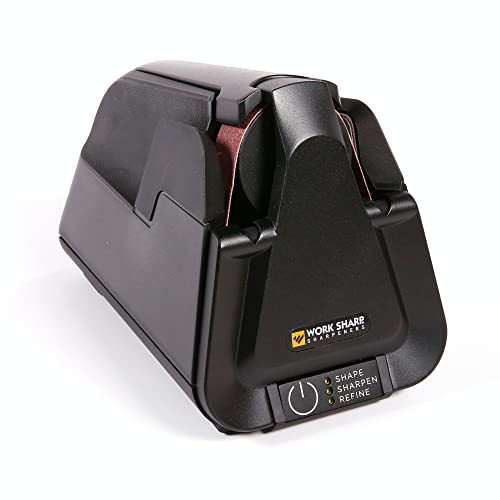
The Culinary E5 is the only machine here that sharpens with flexible abrasive belts, the same basic method knife manufacturers use on production lines. Instead of dragging a blade past a fixed wheel, the belt flexes around the edge, which follows the curve of the blade and produces a convex profile. One Touch programming runs the whole session for you: choose the Shape, Sharpen or Refine program and the machine controls belt speed and timing through the cycle, then shuts itself off, with a full sharpening cycle of about ninety seconds. Stock guides are set at 17 degrees, and an optional upgrade kit adds 15-degree and 20-degree guides plus specialty belts for cooks who want both factory profiles.
The package includes a dual-grit ceramic honing rod with MicroForge technology for touch-ups between full sharpening sessions, so daily maintenance does not require powering the machine up at all. A built-in vacuum pulls in metal dust during sharpening and keeps the counter cleaner than open-wheel designs. Belts are consumables that need periodic replacement, which is the main running cost to plan for, and the fixed stock angle means very acute or very obtuse edges wait for the upgrade guides. The E5 sits in the mid-range to premium tier and carries a three-year warranty on the machine, excluding the abrasive belts.
Specs:
- Model: Culinary E5 (CPE5)
- System: flexible abrasive belts, P120 medium belts included
- Programs: Shape, Sharpen, Refine timed cycles with automatic shut-off
- Guide angle: 17 degrees stock, 15 and 20 degrees with the optional upgrade kit
- Extras: dual-grit ceramic honing rod with MicroForge, built-in vacuum
- Knife types: kitchen knives of all styles, plus scissors and shears
- Dimensions: about 7.2 x 4.5 x 5.2 inches
- Warranty: 3-year, excluding abrasives
4. Chef’sChoice Hybrid 220: Best Compact Hybrid
The Hybrid 220 shrinks the electric sharpener formula into a body a little over seven inches long that stores in a drawer, by splitting the work between one powered stage and one manual stage. Stage one is a motorized sharpening stage running 100-percent diamond abrasive wheels that re-cut a dull 20-degree edge, and stage two is a manual finishing stage that hones and polishes the edge and is also where serrated blades are sharpened. Precision angle guides keep the blade aligned in both stages, so the hybrid layout does not demand any freehand skill.
Because it is built strictly for 20-degree class knives, the 220 is the wrong tool for a drawer full of 15-degree Japanese blades, and its manual second stage takes a little more involvement than the push-through stropping stages on the larger Chef’sChoice machines. In return you get the smallest footprint in this roundup, a mid-range to budget-tier position, and a machine that covers the most common household knives, including serrated bread knives, without claiming counter space permanently. It is a sensible first electric sharpener for small kitchens and for cooks whose knives all share the Western angle.
Specs:
- Model: Hybrid 220 (item 0220100)
- Stages: 2 (stage 1 electric, stage 2 manual)
- Abrasive: 100-percent diamond abrasives
- Edge angle: 20 degrees
- Guides: precision angle guides
- Knife types: straight-edge and serrated 20-degree class knives
- Dimensions: 7.31 x 3.25 x 4 inches
- Warranty: limited manufacturer warranty
5. Presto 08800 EverSharp: Best Budget Pick
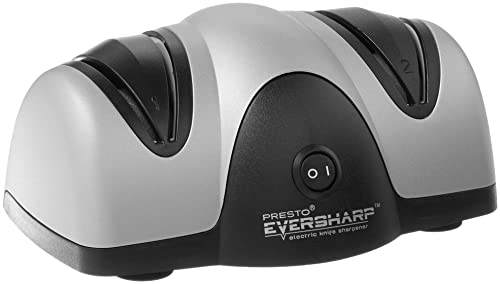
The EverSharp 08800 is the simplest machine in this group and the budget-tier pick. Its two-stage system uses Sapphirite sharpening wheels, an abrasive in the same hardness family as the sapphire used in industrial grinding, to precision-grind the edge in stage one and then fine-hone and polish it in stage two. Precision blade guides position the knife at the ideal sharpening angle automatically, so there are no settings to choose and nothing to adjust: plug the unit in, draw the blade through each stage the recommended number of times, and the edge is done.
Suction-cup feet hold the unit firmly on the counter while you work, and the housing is sized for a cupboard shelf at a little over eight inches wide. The limits match the tier: the EverSharp is built for non-serrated kitchen and sport knives in stainless, carbon and alloy steel, it offers no 15-degree option, and its one-year limited warranty is shorter than the three-year coverage on the premium models. For a drawer of everyday Western knives that need fast, repeatable upkeep without any learning curve, it covers the job and leaves the stropping stages and dual angles to the machines above it.
Specs:
- Model: EverSharp 08800
- Stages: 2 (precision grinding, fine honing)
- Abrasive: Sapphirite sharpening wheels
- Guides: precision blade guides, no adjustment needed
- Knife types: non-serrated kitchen and sport knives
- Dimensions: 8.25 x 5.75 x 4 inches
- Item weight: 2.62 pounds
- Power: 120 volts AC
- Warranty: 1-year limited
Frequently Asked Questions
Can an electric knife sharpener damage my knives?
It can if the machine and the knife are mismatched. A sharpener set for the wrong angle will grind a new bevel into the blade, coarse stages remove metal faster than stones do, and ceramic or single-bevel knives can chip in machines that exclude them. Damage is largely avoidable by matching the sharpener’s angle to the knife, using the finest stage that restores the edge, and keeping excluded blade types away from the slots entirely.
What is the difference between 15-degree and 20-degree edges?
The number is the angle of each side of the edge. A 15-degree edge is thinner and slices with less resistance, which suits Japanese knives and precision cutting, while a 20-degree edge is thicker behind the cutting face and tolerates harder use, bones and dense boards better. Neither is universally better; the practical rule is to maintain the angle the knife came with unless you deliberately convert it, as the 15XV does.
Can electric sharpeners sharpen serrated knives?
Yes, but only in the right stage. Serrated teeth should never go through a coarse grinding slot, which would flatten the serrations. Machines like the 1520, 15XV and Hybrid 220 sharpen serrated blades in their stropping or manual finishing stages, where a flexible or fine abrasive works between the teeth and restores the points without removing the pattern. Fully straight-edge-only models, such as the Presto 08800, should be kept away from serrated blades.
How often should I sharpen kitchen knives?
Sharpen when the knife starts to slide on tomato skin or crush herbs instead of cutting them, which for a home cook is typically every few months of regular use. Honing or stropping is the more frequent task and can be done every few uses to realign the edge between full sharpening sessions. Over-sharpening on coarse stages shortens a knife’s life by removing steel, so use the gentlest stage that brings the edge back.
Conclusion
Match the machine to the drawer and the choice makes itself. Mixed collections of 15-degree and 20-degree knives belong on the Chef’sChoice 1520 AngleSelect, committed 15-degree kitchens get the most from the 15XV EdgeSelect, and cooks who like the factory belt method and timed automation should take the Work Sharp Culinary E5. The Chef’sChoice Hybrid 220 fits small kitchens and single-angle drawers, while the Presto 08800 EverSharp handles everyday Western knives with the least fuss and the lowest commitment. Whichever you choose, keep the angle consistent, reserve coarse stages for genuinely dull blades, and finish on the finest stage available so the edge lasts.