Key takeaways
- Compare the best stretching straps for yoga, physical therapy and mobility work, with looped and buckle designs that make deep stretches easier to reach.
A stretching strap is the simplest flexibility tool there is: a length of non-elastic webbing that extends your reach so tight hamstrings, shoulders, and calves can be stretched with good form instead of rounded backs and strained grasps. Physical therapists prescribe them after injuries, yoga teachers build entire sequences around them, and lifters use them to open hips and ankles before training.
Not all straps work the same way. Looped straps offer a row of hand and foot holds that make progress measurable, while buckle straps adjust to any length and double as alignment aids in yoga poses. This guide compares five current options from established therapy and yoga brands.
As an Amazon Associate, we earn from qualifying purchases.
Quick answer
The OPTP Stretch Out Strap is the best pick for most people: its looped design, included exercise book, and decades of use in physical therapy clinics make it the easiest strap to learn on. Yoga practitioners who prefer an adjustable buckle strap should choose the Tumaz D-Ring model, while the 10-loop Tumaz and Trideer straps suit structured daily mobility routines.
OPTP The Original Stretch Out Strap with Exercise Book, for Flexibility and Mobility Exercises. Stretch Out Straps for Physical Therapy, Yoga Stretching Strap and Knee Therapy Strap. Made in the USA

The OPTP Stretch Out Strap is the original looped stretching strap, and it remains the reference point for the category. Instead of a buckle, it is sewn with a series of loops along its length, so hands and feet always have a secure hold at whatever distance the stretch requires. The webbing is non-elastic woven nylon, which means the strap never stretches out mid-hold and every position is repeatable from one session to the next.
Its biggest advantage for beginners is the included exercise booklet, which illustrates stretches for the hamstrings, calves, shoulders, hips, and back, including the knee and therapy work the strap is widely used for after injury or surgery. The design comes out of physical therapy practice, and that clinical heritage shows in the durable stitching and no-nonsense construction. It is made in the USA.
Trade-offs are minor. A looped strap cannot be shortened into a small yoga belt circle as neatly as a buckle strap, and the fixed loop spacing means hand positions come in steps rather than infinite adjustment. Neither matters much for stretching. For guided, progressive flexibility work, this is the most complete package in the guide.
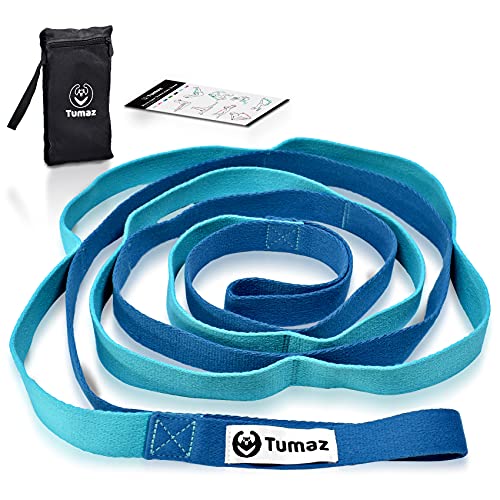
Tumaz Stretching Strap – 10 Loops & Non-Elastic Yoga Strap – The Perfect Home Workout Stretch Strap for Physical Therapy, Yoga, Pilates, Flexibility – [Extra Thick, Durable, Soft]
The Tumaz Stretching Strap follows the looped design with 10 distinct loops, giving closely spaced handholds that make small flexibility gains easy to track: moving one loop further is a satisfying, measurable sign of progress. The strap is non-elastic, so holds stay honest, and the material is noticeably thicker and softer than basic webbing, which keeps edges from biting into palms and the soles of the feet during longer holds.
That softness makes this strap a friendly choice for daily mobility routines, Pilates work, and gentle therapy stretches where comfort determines whether the habit sticks. The loops are sized to fit a foot securely, which matters for hamstring and calf stretches done lying down, and the overall length suits taller users as well as shorter ones.
Trade-offs are the usual looped-strap ones: no buckle means no quick conversion into an adjustable yoga belt, and the plush material is slightly bulkier to pack than thin webbing. It also lacks an included exercise guide, so beginners may want a video or book alongside it. For comfort-focused home stretching, it is an easy recommendation.
Tumaz Yoga Strap/Stretch Bands [15+ Colors, 6/8/10 Feet Options] with Extra Safe Adjustable D-Ring Buckle, Durable and Comfy Delicate Texture – Best for Daily Stretching, Physical Therapy, Fitness

The Tumaz Yoga Strap takes the other classic approach: a long, smooth strap with a metal D-ring buckle that adjusts to any length and locks under tension. That adjustability is what yoga practice asks for, since the same strap serves as a reach extender in forward folds, a shoulder opener, and an alignment loop around the feet or thighs in seated poses. Length options of 6, 8, and 10 feet let buyers match the strap to their height and practice.
The fabric has a soft, cotton-like texture that is comfortable against skin and easy on the hands, and the D-ring design is sturdier and simpler to thread than plastic buckles. For therapy use, the buckle allows precise, repeatable lengths once a position is dialed in.
Trade-offs: a smooth strap offers no fixed handholds, so tracking progress is less precise than with loops, and threading the buckle takes a moment longer than grabbing a loop. Very long lengths can feel like excess material in simple stretches. As a do-everything yoga and stretching belt, though, it is the most versatile design here.
Trideer Stretching Strap Yoga Strap Physical Therapy for Home Workout, Exercise, Pilates and Gymnastics, 10 Loops Non-Elastic Stretch Bands with Aesthetic Packaging for Women & Men (Black)

The Trideer Stretching Strap is another 10-loop design, aimed squarely at home workout and therapy routines. The non-elastic webbing provides a stable hold for hamstring, calf, hip, and shoulder stretches, and the loop spacing gives the same progress-tracking benefit as the other looped models: each new loop reached is a small milestone. The strap’s construction is sturdy, with reinforced stitching at the loops where stress concentrates.
It is positioned as an all-purpose mobility tool, covering physical therapy exercises, Pilates, gymnastics mobility work, and general flexibility training, and the black colorway keeps it looking at home in a gym bag. The loops accommodate hands or feet, and the length works for the standard supine stretching sequences most routines are built on.
Trade-offs mirror its direct rivals. There is no buckle for yoga-belt duties, and no included exercise programming, so new users will lean on outside guidance at first. The webbing is functional rather than plush, so long barefoot holds feel firmer than with the softer Tumaz looped strap. As a durable, no-frills looped strap, it does exactly what the category promises.
TECEUM Stretching Strap for Yoga & Physical Therapy – 10 Loops – Non-Elastic Leg Stretch Straps for Stretching, Exercising, Pilates, Post-Injury Rehabilitation for All Levels – Men & Women
The TECEUM Stretching Strap rounds out the looped options with a 10-loop, non-elastic design pitched at all experience levels, from first-time stretchers to people working through post-injury rehabilitation. The loops give secure purchase for hands and feet during leg stretches, hip openers, and shoulder mobility work, and the strap holds its length under load so stretches stay controlled and repeatable.
Its rehabilitation framing is worth noting: the strap is marketed for the gradual, position-by-position stretching that recovery programs use, where the ability to move one loop at a time maps neatly onto week-by-week progress. The material is a durable woven webbing that balances grip and comfort, and the strap is light enough to travel with, which helps consistency during work trips or holidays.
Trade-offs are shared with the other looped straps: no buckle adjustment, and no bundled exercise instruction beyond the basics. Buyers choosing between the looped rivals are mostly choosing on feel and availability rather than capability. For structured home stretching and rehab support, the TECEUM is a sound, affordable entry in the format.
How to choose
Choose the format first. Looped straps give fixed handholds that make progress measurable and keep feet secure, which suits stretching routines, mobility work, and physical therapy. Buckle straps adjust to any length and serve double duty as yoga belts, which suits flow practices and alignment work.
Length comes next. Most adults do well with a strap around six feet for standard stretches. Taller users, and anyone planning yoga poses that loop the strap around the body, should consider eight or ten feet. Excess length is easy to fold away; a strap that is too short simply limits poses.
Material and comfort matter over months of use. Non-elastic webbing is essential, since stretchy bands change the exercise entirely. Softer, thicker straps feel better in bare hands and on feet, while thinner webbing packs smaller and dries faster.
Finally, consider guidance. Beginners benefit from an included exercise book or a strap brand with clear routine support. If you already follow a therapist’s program or a yoga teacher, any well-made strap in the right format will do the job.
Who should skip
Skip a stretching strap if a clinician has told you to avoid stretching a healing injury, since straps make it easy to push deeper than recovering tissue allows. People whose flexibility work is entirely band-based mobility and loaded stretching may find a strap duplicates tools they already own. Very advanced yoga practitioners who never use props can also pass. And if your goal is strength through full range of motion rather than flexibility itself, resistance bands and guided mobility programs may serve you better than a passive stretching aid.
FAQ
Are looped straps or buckle straps better?
Neither is universally better; they suit different work. Looped straps excel at stretching routines and therapy exercises because the loops give secure, repeatable hand and foot positions. Buckle straps excel at yoga because they adjust to any length and form circles for alignment. Many regular practitioners eventually own one of each.
How long should a stretching strap be?
Around six feet covers most stretching for most adults. Taller people, and yoga practitioners who use the strap around the torso or in wide poses, often prefer eight or ten feet. When in doubt, size up: extra length can be doubled over or left hanging, while a short strap cannot be extended.
Can a stretching strap help after knee or hip surgery?
Straps are commonly used in rehabilitation to restore range of motion gradually, including gentle knee and hip mobility work. The looped format helps because each loop is a small, controlled step. That said, post-surgery stretching should follow the program your surgeon or physical therapist sets, not a general guide, so clear any routine with them first.
How often should I stretch with a strap?
Short, regular sessions beat occasional long ones. Ten to fifteen minutes most days, holding each stretch gently for roughly twenty to thirty seconds without bouncing, suits general flexibility goals. Mild tension is the target sensation; sharp or joint pain is a signal to back off. Consistency over weeks is what produces visible change.
Final verdict
The OPTP Stretch Out Strap is the safest first purchase: a proven looped design, an exercise book to learn from, and construction that lasts for years. The Tumaz 10-loop strap is the comfort pick for daily mobility work, the Trideer matches it as a sturdy no-frills alternative, and the TECEUM serves rehab-focused routines well. Yogis should choose the adjustable Tumaz D-Ring strap. Pick the format that matches your practice and any of these five will earn its place.