
Key takeaways
- Under $150, the Ninja CREAMi NC301 suits the buyer who wants single-pint, freeze-ahead desserts in many styles, while the Cuisinart Pure Indulgence…
Under $150, the Ninja CREAMi NC301 suits the buyer who wants single-pint, freeze-ahead desserts in many styles, while the Cuisinart Pure Indulgence ICE-30BCP1 suits a family that wants a bigger batch from a classic freezer-bowl machine and is happy to plan a day ahead. A true self-chilling compressor machine sits in a higher tier than this cap, so if you want ice cream on a whim with no pre-freezing, be ready to budget more.
Our top picks



As an Amazon Associate we earn from qualifying purchases at no extra cost to you.
Two different ways to make ice cream
These machines work in different ways, and that drives the decision more than any spec.
- Freezer-bowl churners have a bowl with a sealed coolant that you freeze in advance. You pour in a cold liquid base, and a paddle churns it as it freezes against the bowl wall. Batches are quick once the bowl is frozen, but the bowl must be frozen first and only one batch is possible before it warms.
- Pint-freezing processors like the Ninja CREAMi work the other way: you freeze a base solid in a pint container, then a blade shaves and re-textures it. The wait is in the freezer, not the machine, and each pint is a separate batch.
At a glance
| Model | Best for | Key stated specs | Limits |
|---|---|---|---|
| Ninja CREAMi NC301 | Single-serve pints, healthier or low-sugar bases, many dessert styles | The maker lists seven programs: Ice Cream, Lite, Sorbet, Gelato, Milkshake, Smoothie Bowl and Mix-in; 800 W, 120 V; two 16-oz pints included; about 15.94 lb; 17.44 x 8.58 x 18.39 in.; 1-year warranty | Bases must be frozen in the pint first; heavy and tall; noisy as the blade runs; one pint per cycle |
| Ninja CREAMi NC299AMZ | Same function, one-pint variant | Third-party pages describe the same seven programs and 800 W motor in a black finish; most say it ships with one pint rather than two, though a few sources disagree on the pint count; the maker’s own site lists the NC301 | Details come from third-party pages, so listings differ on smaller points |
| Cuisinart Pure Indulgence ICE-30BCP1 | Larger family batches of classic ice cream, sorbet and frozen yogurt | The maker lists a fully automatic 2-quart capacity, double-insulated freezer bowl, large ingredient spout, brushed metal housing, BPA-free parts and a limited 3-year warranty; about 8.25 x 8.25 x 11.5 in. | Freezer bowl needs pre-freezing; one retailer says parts are not dishwasher-safe |
Ninja CREAMi NC301: flexible, but plan ahead
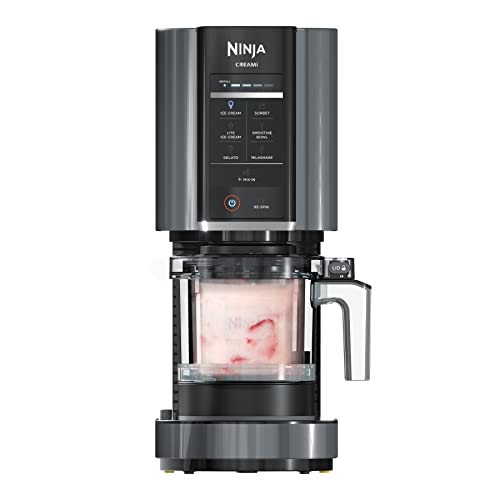
The NC301 is listed on Ninja’s site as a seven-in-one ice cream maker. Its programs cover ice cream, a lighter version, sorbet, gelato, milkshake, smoothie bowl, and a mix-in function for adding candy or cookie pieces. The box includes two 16-oz pints, and a retailer listing adds a Creamerizer paddle, outer bowl and lid, storage lids and a 30-recipe guide. Ninja lists the unit at 800 W on 120 V with a 31.5 in. cord.
For many households the appeal is control. You can freeze almost any base in the pint, whether it is a low-sugar mix, a dairy-free blend or fruit. You then run the pint and, if the texture is crumbly, use a re-spin function if the manual describes one. Reviewers often comment that texture depends heavily on the base, and that low-fat or low-sugar bases can come out crumbly. The recipe guide and the maker’s instructions are the place to learn the process.
Practical points: the machine is a tall 18-inch unit and weighs close to 16 lb, so it needs a permanent counter spot or a cabinet home. The freezing is done in your freezer, so you need enough freezer space for pints standing level. Since you must freeze each pint for a long period before processing, this is not a spur-of-the-moment machine. The maker lists the pints and parts as dishwasher-safe and BPA-free.
The NC299AMZ is described by third-party sites as nearly identical, in a black finish, with the number of included pints differing between sources. Because those sites differ on smaller details such as display and materials, rely on the maker’s NC301 page for specs and confirm what is in the box before buying.
Cuisinart ICE-30BCP1: the classic bowl-and-paddle machine
Cuisinart’s page lists the ICE-30BCP1 as fully automatic, making up to two quarts of frozen desserts or drinks, with timing described as “as little as 25 minutes” in one place and 20 minutes in another, so the page is inconsistent. It lists a double-insulated freezer bowl, a large spout for adding mix-ins while it runs, a brushed metal housing, BPA-free construction and a limited 3-year warranty. The listed size is about 8.25 inches square and 11.5 inches tall, with a weight in the range of 13 pounds.
The bowl needs time in the freezer first. An independent review says at least 12 hours and preferably 24, and that the practical batch size is smaller than the headline: about 900 ml of mix yields roughly 1,100 ml of ice cream, because ice cream expands as it churns. If you plan to serve a crowd, factor that in. A retailer listing also says no ice or salt is needed and that parts are not dishwasher-safe, so hand-wash as the manual directs.
This style gives you soft-serve consistency straight from the bowl, which many people like for fresh churned flavor. To harden it, you move it to the freezer for a couple of hours. The downside is batch-to-batch waiting: the bowl must be refrozen before a second batch.
Where the cap draws the line
Compressor machines with built-in freezing, which make batch after batch on demand without pre-freezing, are generally sold in a higher price tier than this cap. If that is your goal, plan to stretch beyond $150. If your priority is a low outlay, the freezer-bowl style is the long-standing budget route, and the CREAMi approach sits in the upper part of the budget range depending on the listing.
Fit, size and care notes
- Freezer space: both approaches need freezer room, either for the bowl or for the pints.
- Counter and storage: the NC301 is taller; the Cuisinart bowl-and-base design is more compact but the bowl itself is bulky in a small freezer.
- Cleaning: follow the manual for each machine. Do not put the freezer bowl in a dishwasher unless the maker states it is allowed.
- Food safety: raw egg bases carry a risk. Use pasteurized eggs or cook the custard, and keep finished ice cream frozen. Anyone with allergies should check ingredients and avoid cross-contact with shared pints and paddles.
Getting good texture at home
Homemade ice cream has no commercial stabilizers, so texture depends on the recipe. A higher proportion of fat and sugar gives a softer, creamier result, while low-sugar and low-fat bases freeze harder and form larger ice crystals. Chill the base thoroughly before it goes into a freezer-bowl churner, since a warm base melts the bowl’s coating of cold and leaves a runny result. For pint-style machines, freeze the base on a level shelf so the surface is flat, and follow the maker’s guidance on how long to freeze it. Add mix-ins near the end of churning so they are distributed without being crushed.
Finished ice cream is best eaten within a few days, because homemade versions harden and develop ice crystals in storage. Pressing a layer of baking paper onto the surface before closing the container helps. Because the machines in this guide are for occasional dessert making, consider whether you will use one weekly. If you only make ice cream a few times a year, a simple no-churn recipe may meet your needs without a new appliance.
Pick X if…
| Pick this | If you… |
|---|---|
| Ninja CREAMi NC301 | want single pints, many dessert styles and flexible bases, and have freezer room |
| Cuisinart ICE-30BCP1 | want a simple, larger churn for family batches and can freeze the bowl a day ahead |
| A higher-tier compressor machine | want ice cream on demand without pre-freezing and can go beyond the cap |
Alternatives
- No-churn recipes: whipped cream and condensed milk bases freeze in a loaf pan with no machine at all, with a different, denser texture.
- Hand-crank or ice-and-salt churners: these old-style machines are a low-cost route for occasional batches and are fun with children.
- Frozen fruit and a blender: for sorbet-style desserts, a strong blender with frozen fruit is another option.
Frequently Asked Questions
How long does the Cuisinart freezer bowl need to freeze?
One independent review says at least 12 hours, ideally 24. Follow the manual, and keep the bowl in a cold freezer so it is solid when you use it. A bowl that sloshes when shaken is not ready.
What is the difference between the Ninja CREAMi NC301 and NC299AMZ?
Third-party sites describe them as nearly the same machine, with the NC299AMZ in black and the NC301 in silver; most sources say the NC299AMZ ships with one pint and the NC301 with two, but sources conflict, so check the pint count on the listing. Ninja’s own site lists the NC301, so treat the NC299AMZ details with caution.
Can I make dairy-free or low-sugar ice cream?
Yes, with either style, but texture changes. Low-sugar and low-fat bases tend to freeze harder, and reviewers report crumbly results in the pint style. Follow the maker’s recipe guidance.
Is homemade ice cream safe to eat?
It can be, if you handle ingredients properly. Use pasteurized eggs or a cooked custard, keep ingredients cold, and wash parts after each use according to the manual. People with allergies or weakened immune systems should be cautious and ask a healthcare professional if unsure.
Do I need ice and salt?
Not with either of the machines in this guide. A retailer listing says the Cuisinart ICE-30BCP1 needs no ice or salt, and the CREAMi relies on a frozen pint.
How much freezer space do I need?
For the Cuisinart, enough room for the freezer bowl to sit flat. For the CREAMi, room for pints to stand level. Plan for this before buying.
