Key takeaways
- Compare the best gym timers for interval training, from pocket stopwatch timers to app-controlled LED wall clocks for home gyms and group workouts.
Interval training lives and dies by the clock. Whether the session is Tabata rounds, EMOM lifting, or simple work-and-rest circuits, a proper gym timer keeps the pace honest in a way a phone on the floor never quite does. Phones lock, notifications interrupt, and small screens are hard to read from across the room mid-set.
Dedicated timers solve those problems with loud alerts, big displays, and programs that run themselves once started. This guide compares five current options: three pocket-sized Gymboss units that clip to a waistband, and two LED wall clocks built for home gyms and group classes. The differences that matter are programmability, alert style, display size, and power source.
As an Amazon Associate, we earn from qualifying purchases.
Quick answer
The Gymboss Charge is the best pick for most home trainers: it programs intervals in seconds, offers beep and vibration alerts, and recharges by USB instead of eating disposable batteries. Lifters who want a big wall display should choose the GymNext Flex Timer, while the original Gymboss remains the simplest, toughest budget option for straightforward interval work.
Gymboss Interval Timer and Stopwatch – Black/Blue SOFTCOAT
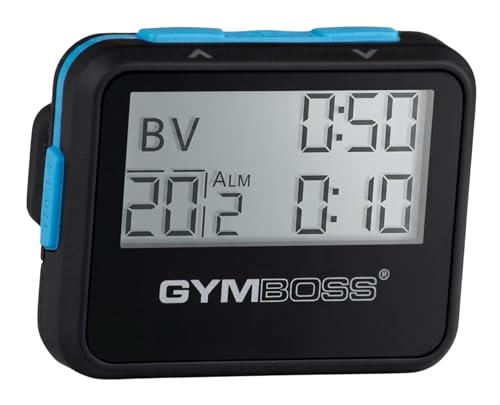
The original Gymboss Interval Timer is the device that defined the category, a pocket-sized unit built for one job: running intervals without fuss. It times one or two different intervals, from a couple of seconds up to 99 minutes, and can repeat them for a set number of rounds or run continuously until stopped. A stopwatch mode is built in for general timing.
Alerts are where the Gymboss earns its keep. It offers a high beep, a low beep, vibration, or combinations of beep and vibration, with adjustable alarm duration, so it works in a loud garage gym or a quiet apartment where vibration on a waistband is the polite option. The SOFTCOAT finish adds grip, and a belt clip and lanyard options keep it attached during movement-heavy workouts. It runs on a single AAA battery.
The trade-offs are era-related. The small screen and button-based programming feel dated next to app-controlled clocks, and there is no way to save multiple named workouts. It is also easy to misplace something this small. For simple, reliable interval timing that survives being tossed in a gym bag for years, it remains the benchmark.
Gymboss miniMAX Interval Timer and Stopwatch – Black/Yellow SOFTCOAT

The Gymboss miniMAX takes the original formula and adds programming depth for trainers whose workouts change shape from day to day. It can run up to 25 repeating cycles and handle more complex interval structures than the standard model, including multiple different interval lengths inside a single session, which suits boxing rounds, mixed circuits, and conditioning ladders.
It keeps everything that made the original popular: beep, vibration, and combination alerts with adjustable duration, a stopwatch mode, the grippy SOFTCOAT casing, and a belt clip for wearing during training. Power still comes from a single AAA battery, which means a spare in the gym bag guarantees the timer never dies mid-program.
The trade-offs mirror the original’s. Programming longer sequences through a small screen and a few buttons takes patience the first few times, and there is no display big enough for a class to follow. Trainers who run the same two or three workout templates will use only a fraction of its depth. For individuals whose interval work is genuinely varied, though, the miniMAX is the most capable pocket timer in this roundup.
Gymboss Charge Interval Timer and Stopwatch

The Gymboss Charge updates the classic design around the one annoyance every long-term Gymboss owner knows: disposable batteries. The Charge is rechargeable, topping up over USB, so it can live on the same charging routine as a phone or headphones. For a device used daily, that convenience adds up quickly.
Functionally it stays true to the family formula. It programs one or two intervals with repeat options, includes a stopwatch mode, and offers the familiar beep, vibration, and combined alerts with adjustable alarm duration. The housing keeps the compact, clip-on form that makes Gymboss timers easy to wear through conditioning work, and the controls follow the same logic as the other models, so existing users will feel at home immediately.
Trade-offs are few but real. A rechargeable battery means the timer needs planning: if it is flat, there is no swapping in a fresh cell to save the session. It also costs more than the battery-powered original. For most home trainers, though, the Charge is the easiest Gymboss to own, and it is the pocket timer recommended first in this guide.
GymNext Flex Timer – Home Edition – Bluetooth App-Controlled Wall Mounted 13″ LED Gym Clock with Medium 2.3″ Digits
The GymNext Flex Timer – Home Edition moves timing to the wall, where a whole room can see it. The 13-inch LED display uses 2.3-inch digits that stay readable from across a garage gym, and the clock handles count up, count down, interval programs, Tabata structures, and fight-gone-bad style formats. It is controlled over Bluetooth from the GymNext phone app, which turns programming into tapping on a phone screen instead of wrestling with a remote.
App control also means saved workouts, quick edits between rounds, and firmware-driven features that a standalone clock cannot match. The Home Edition is sized for personal spaces rather than commercial facilities, and it mounts on the wall or sits on a surface near the training area.
The trade-offs are dependence and setup. The timer needs its app for full programming, so a phone stays part of the workout, and wall mounting plus a power outlet within cable reach require a little planning. It is also the largest investment among the pocket timers here by a wide margin. For a dedicated home gym where visibility matters, it is in a different league.
BTBSIGN LED Interval Timer Count Down/Up Clock Stopwatch with Remote for Home Gym Fitness
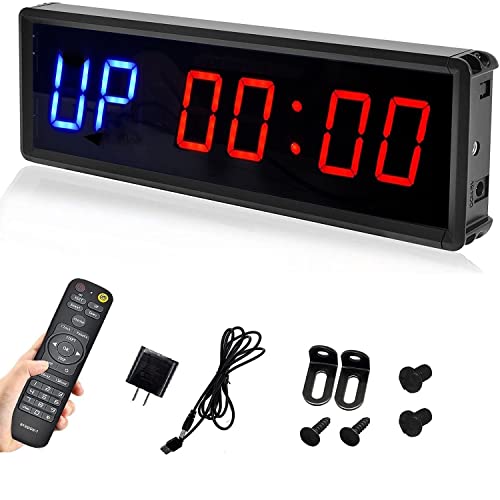
The BTBSIGN LED Interval Timer offers the wall-clock experience at a friendlier tier, with a remote control instead of an app. The LED display handles the core modes home gyms use most: count down, count up, stopwatch, and programmable interval training with work and rest periods. Digits are large enough to read mid-workout from a few meters away, which is the main reason to choose a clock over a pocket timer.
The included remote lets the user program and adjust sessions from the training floor, and the clock can hang on a wall or stand on a flat surface. For households that run circuits, follow-along workouts, or timed mobility routines in one shared space, that visibility keeps everyone synchronized without shouting times across the room.
Trade-offs reflect the tier. The remote is another small item to keep track of, programming depth is shallower than the app-driven GymNext, and the display, while clear, is not as large as premium gym clocks. Sound options are also more basic. As a first wall timer for a home gym, however, it covers the essential modes well and keeps the phone out of the workout.
How to choose
Start with format. Pocket timers clip to clothing and work anywhere, including outdoor sessions and travel, but only the wearer can follow them. Wall clocks serve a whole room and stay readable at distance, which suits fixed home gyms and group training.
Next, look at programming. Simple two-interval timers cover most conditioning work. If your training uses ladders, mixed round lengths, or many saved templates, an app-controlled clock or the miniMAX saves real frustration.
Alert style matters more than expected. Beeps carry across noisy rooms but annoy apartment neighbors; vibration works for solo training but is useless on a wall clock. Adjustable volume and alarm duration give the most flexibility.
Finally, weigh power and placement. Battery and USB-rechargeable pocket timers go anywhere. Wall clocks need an outlet and a mounting spot with clear sight lines from your main training positions. Buy for the space you actually train in, not the one you plan to build someday.
Who should skip
Skip a dedicated gym timer if your training is pure strength work with untimed rest periods, since a wall clock or phone stopwatch already covers that. Lifters who train exclusively with a coach or in classes where the facility provides timing gain little from owning one. Phone-app loyalists who already run a timing app on a mounted tablet may also find a separate device redundant. And if workouts happen in several changing locations, a pocket timer makes more sense than any wall clock on this list.
FAQ
What is the difference between a gym timer and a stopwatch?
A stopwatch only measures elapsed time, while a gym timer runs pre-set work and rest intervals and signals each change automatically. That automation is the point: the timer counts rounds, watches the rest periods, and alerts the room, so the athlete can focus on the exercise instead of checking a screen after every set.
How loud should a gym timer be?
Loud enough to hear over music and breathing from your normal training distance, but adjustable for shared spaces. Pocket timers with vibration alerts solve the noise problem for apartments and early-morning sessions. Wall clocks usually offer volume settings; test the alert from your farthest training position before mounting the clock permanently.
Can one timer work for a whole class?
Yes, if the display is large enough. Wall clocks with digits over two inches stay readable across most rooms, which is why they are standard in group facilities. Pocket timers only serve the person wearing them, since the screen is small and the alert is local. For classes, choose the biggest display your space and budget allow.
Do gym timers need Wi-Fi or a phone?
Most do not. Classic pocket timers and remote-controlled clocks run entirely on their own hardware. App-controlled models like the GymNext use Bluetooth to a phone for programming, but the workouts then run on the clock itself. A phone-free setup is easy to achieve if that is a priority.
Final verdict
For most people, the Gymboss Charge is the timer to buy: proven interval programming, beep and vibration alerts, and USB charging in a pocket-sized unit. The original Gymboss stays the value benchmark, and the miniMAX adds depth for complex programs. If training happens in one fixed space, the GymNext Flex Timer’s app control and big display are worth the step up, while the BTBSIGN clock delivers the wall-timer essentials for less.